


Design and Reconstruction of a Waste Sorting Plant with a Capacity of 422,400 t/year
Astana city- Capacity: 80 tons/hour (422,400 tons/year)
- Total building area: 9,582.88 m²
- Building footprint: 9,892.0 m²
- Building volume: 87,023 m³
- Foundation type: Monolithic spread footings
- Wall material: 120 mm sandwich panels (TSP-Z)
- Roofing: 100 mm sandwich panels (TSP-K)
- Clearance height (to underside of structure): 9.4 m
-
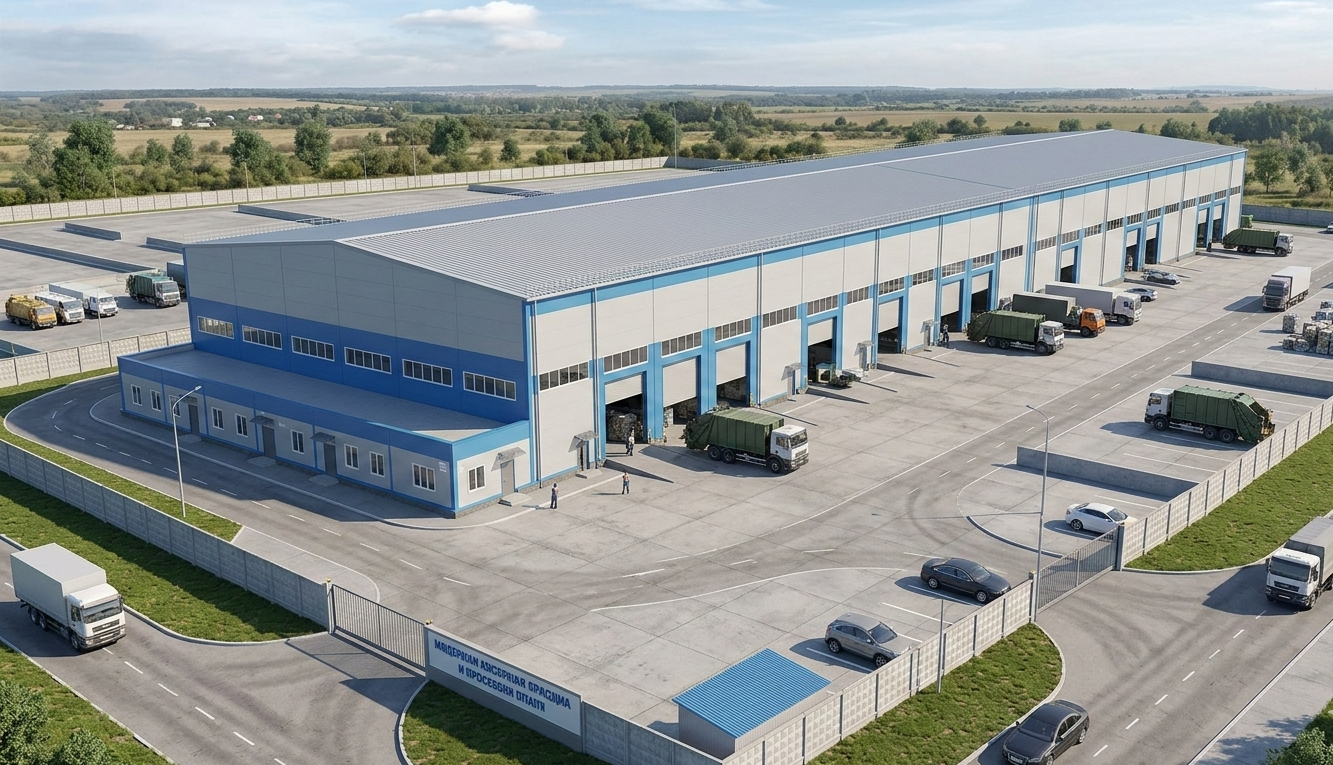
-
We present a project for the deep modernization and expansion of a high-tech waste sorting complex. With a total area of 9,582.88 m², the facility is designed as a cutting-edge closed-loop enterprise, where innovative engineering solutions are paired with maximum environmental efficiency.
Scale and Architectural Solutions
The main plant building is an impressive rectangular structure with dimensions of 186.0 x 48.0 m across the axes. During this large-scale reconstruction, the building was expanded to increase the storage area capacity and to integrate the latest technological equipment.
The minimum clearance height to the underside of the load-bearing structures at the ridge is 9.4 m, which allowed for the integration of multi-level automated lines within the workshop space. The building is divided into two strategic sectors: a spacious storage area with a loading zone, and the main waste sorting and baling shop.
Modern Technological Processes
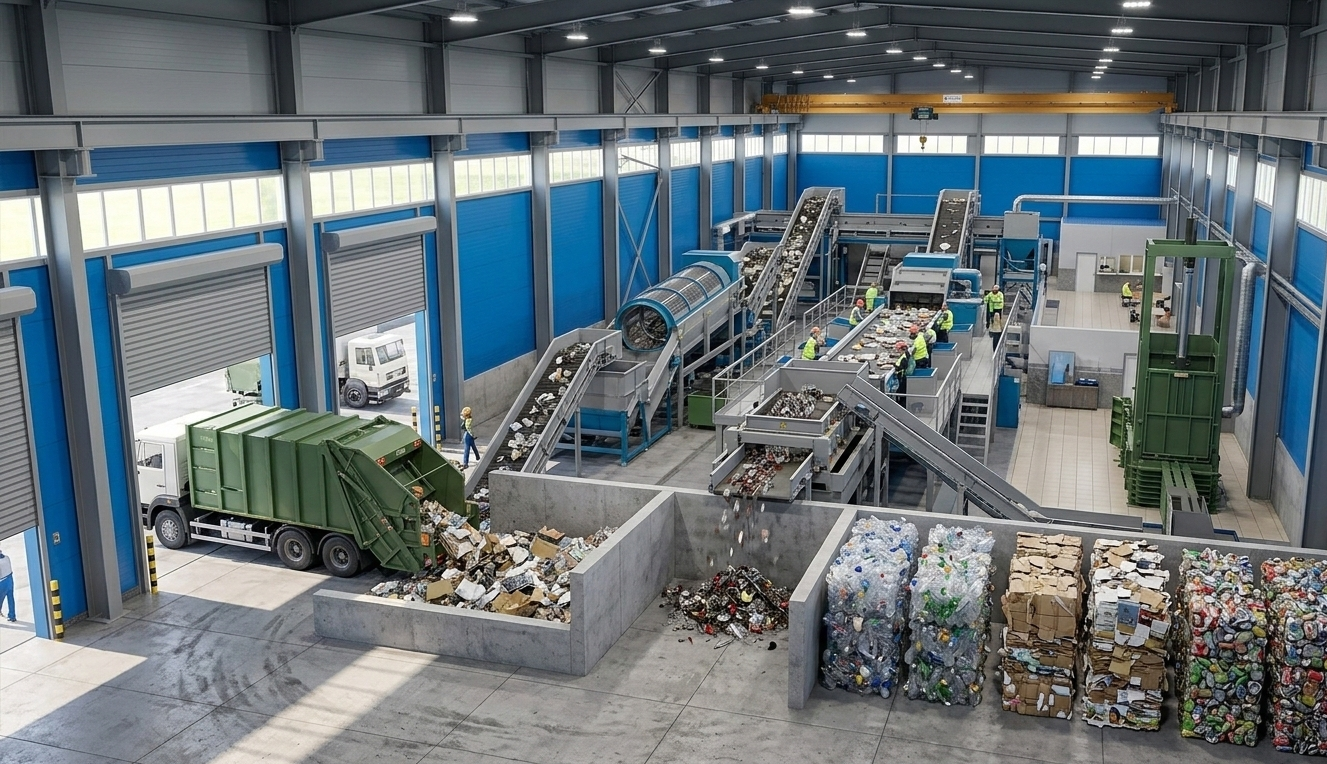
This plant is more than just a processing site; it is a finely tuned intelligent system. Within the framework of the project, modern automated lines have been implemented, ensuring precision sorting of MSW (Municipal Solid Waste) across key categories:
- Ferrous and non-ferrous metals (magnetic separation);
- Cardboard and waste paper (extraction of clean fractions for secondary production);
- Polymers and plastics (sorting by type and color);
- Organic (food) waste (screening for further disposal).
Virtually all incoming waste undergoes a full processing cycle: from primary calibration to final packaging. High-performance balers provide compact briquetting of secondary raw materials, which significantly reduces logistics costs. All processes at the enterprise are highly streamlined, modern, and oriented toward achieving a throughput capacity of 80 tons per hour.
Structural Reliability
The facility was constructed using durable and energy-efficient materials:
- Foundations: Monolithic spread footings.
- Walls and Roofing: Three-layer sandwich panels (120 mm and 100 mm) with mineral wool insulation according to GOST 32603-2012, providing excellent thermal insulation.
- Logistics: Insulated sliding and sectional doors with electric drives for the seamless movement of machinery.
- Comfort: The building includes a modern block of domestic premises (rest areas, heating rooms, restrooms) and technical hubs (electrical switchboard room, heat distribution point).

